
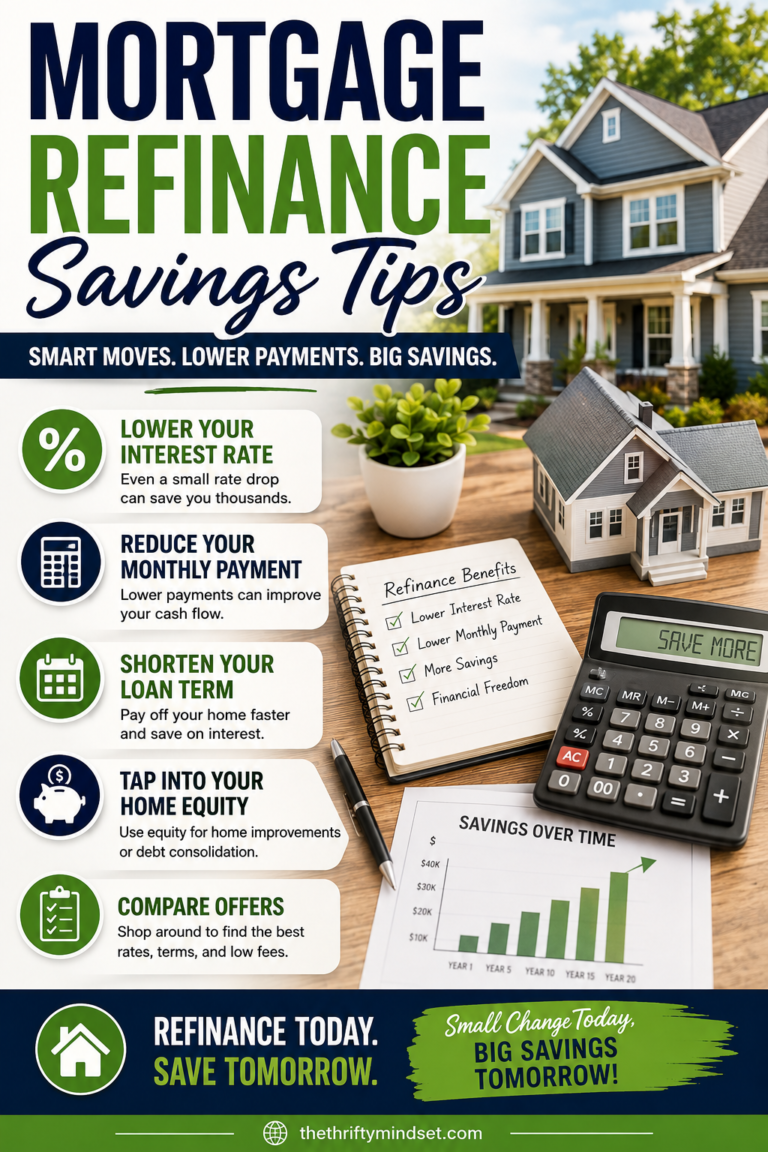
Refinancing your mortgage can be one of the smartest financial decisions you make—if you do it at the right time and for the right reasons. While many homeowners refinance to secure a lower interest rate, there are several other ways refinancing can help reduce monthly payments, shorten loan terms, eliminate unnecessary costs, and save tens of thousands of dollars over the life of a loan.
However, refinancing isn’t always the right move. Closing costs, loan terms, credit requirements, and market conditions all play a major role in determining whether you’ll actually save money.
In this guide, we’ll cover practical mortgage refinance savings tips that help homeowners make informed decisions and maximize their long-term savings. Whether you’re refinancing for the first time or considering another refinance, these strategies can help you avoid costly mistakes.
What Is Mortgage Refinancing?
Mortgage refinancing means replacing your current home loan with a new one. The new mortgage pays off your existing loan, and you begin making payments under the new loan terms.
Homeowners typically refinance to:
- Reduce their interest rate
- Lower monthly mortgage payments
- Shorten the loan term
- Switch between adjustable-rate and fixed-rate mortgages
- Access home equity through a cash-out refinance
- Remove mortgage insurance
The goal should always be improving your financial situation—not simply getting a new loan.

Why Refinancing Can Save You Thousands
Even a small reduction in your interest rate can create substantial savings.
Example
Suppose you have:
- Loan balance: $300,000
- Current interest rate: 7.2%
- Remaining term: 30 years
Refinancing to 5.9% could reduce your monthly payment by hundreds of dollars and potentially save over $80,000 in interest throughout the life of the loan.
Of course, actual savings depend on:
- Remaining loan balance
- Years left on your mortgage
- Closing costs
- New interest rate
- Loan term
That’s why comparing the total cost—not just the monthly payment—is essential.
Tip 1: Don’t Refinance Just Because Rates Drop
One of the biggest refinancing mistakes homeowners make is assuming every lower interest rate is worth pursuing.
A refinance should provide meaningful savings after accounting for:
- Loan origination fees
- Appraisal costs
- Title insurance
- Closing costs
- Recording fees
- Prepaid taxes and insurance
For example, saving $75 per month may sound appealing. But if refinancing costs $6,000, it could take years before you actually start saving money.
Always calculate your break-even point.
Break-Even Formula
Closing Costs ÷ Monthly Savings = Months to Recover Costs
Example:
Closing costs: $4,800
Monthly savings: $160
Break-even:
4,800 ÷ 160 = 30 months
If you expect to stay in your home longer than 30 months, refinancing may make financial sense.
Tip 2: Improve Your Credit Score Before Applying
Mortgage lenders reward borrowers with excellent credit by offering lower interest rates.
Even a modest improvement in your credit score could significantly reduce your borrowing costs.
Before applying:
- Pay down credit card balances.
- Make every payment on time.
- Avoid opening new credit accounts.
- Correct errors on your credit report.
- Keep credit utilization low.
For many borrowers, waiting a few months to improve their credit score can lead to much larger lifetime savings than refinancing immediately.

Tip 3: Shop Around Instead of Accepting the First Offer
Many homeowners refinance with their current lender without comparing alternatives.
This can be expensive.
Interest rates and lender fees vary widely.
Request Loan Estimates from multiple lenders and compare:
- Interest rate
- Annual Percentage Rate (APR)
- Origination fees
- Discount points
- Closing costs
- Processing fees
- Underwriting fees
Even if one lender offers the same interest rate, lower fees could save you thousands.
Getting several quotes also gives you leverage to negotiate better terms.
Tip 4: Compare APR Instead of Just Interest Rates
An advertised interest rate doesn’t tell the whole story.
The Annual Percentage Rate (APR) includes many of the loan’s fees, making it a better comparison tool.
Example:
Loan A
Interest Rate: 5.80%
APR: 6.20%
Loan B
Interest Rate: 5.95%
APR: 6.00%
Although Loan A advertises the lower rate, Loan B may actually cost less overall because of lower fees.
Always compare both numbers before making a decision.
Tip 5: Choose the Right Loan Term
Many homeowners automatically refinance into another 30-year mortgage.
While this lowers monthly payments, it can dramatically increase the total interest paid.
Consider your goals.
A 30-Year Loan May Be Best If You Want:
- Lower monthly payments
- Greater monthly cash flow
- More budget flexibility
A 20-Year Loan May Be Best If You Want:
- Lower total interest
- Faster homeownership
- Moderate monthly payments
A 15-Year Loan May Be Best If You Want:
- Pay off your home sooner
- Build equity faster
- Save significantly on interest
A shorter loan often comes with lower interest rates, making it an attractive option for homeowners who can comfortably afford the higher monthly payment.
Tip 6: Eliminate Private Mortgage Insurance (PMI)
If your home has increased in value or you’ve paid down enough of your loan, refinancing could eliminate Private Mortgage Insurance (PMI).
PMI is generally required when homeowners have less than 20% equity.
Once your equity exceeds 20%, refinancing may allow you to remove this monthly expense.
Many homeowners save:
- $100
- $200
- Even $400 per month
Simply by eliminating PMI.
This can make refinancing worthwhile even if interest rates haven’t changed dramatically.

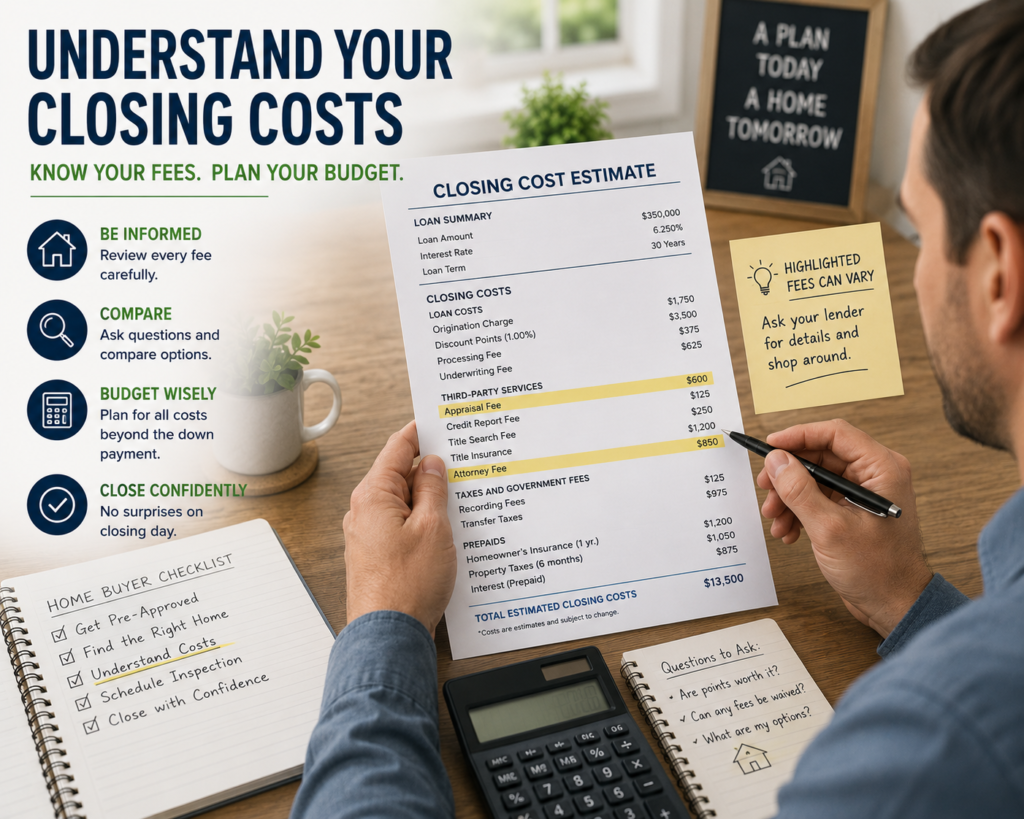
Tip 7: Understand Closing Costs Before Signing
Refinancing isn’t free.
Typical refinancing costs include:
- Loan origination fee
- Appraisal
- Credit report
- Attorney fees (where applicable)
- Title insurance
- Recording fees
- Flood certification
- Escrow funding
These expenses often range from 2% to 6% of the loan amount.
Ask your lender for a detailed breakdown so there are no surprises.
Don’t hesitate to question any unfamiliar fees or negotiate where possible.
Tip 8: Decide Whether Buying Discount Points Makes Sense
Mortgage discount points allow borrowers to pay upfront fees in exchange for a lower interest rate.
Generally:
- One discount point costs about 1% of the loan amount.
- It reduces your interest rate by a small amount.
Buying points can make sense if you plan to stay in your home for many years, allowing enough time to recover the upfront cost through lower monthly payments.
If you expect to move within a few years, paying for discount points may not provide enough savings to justify the expense.
Common Refinancing Mistakes to Avoid
Even experienced homeowners make mistakes during the refinancing process. Avoid these common pitfalls:
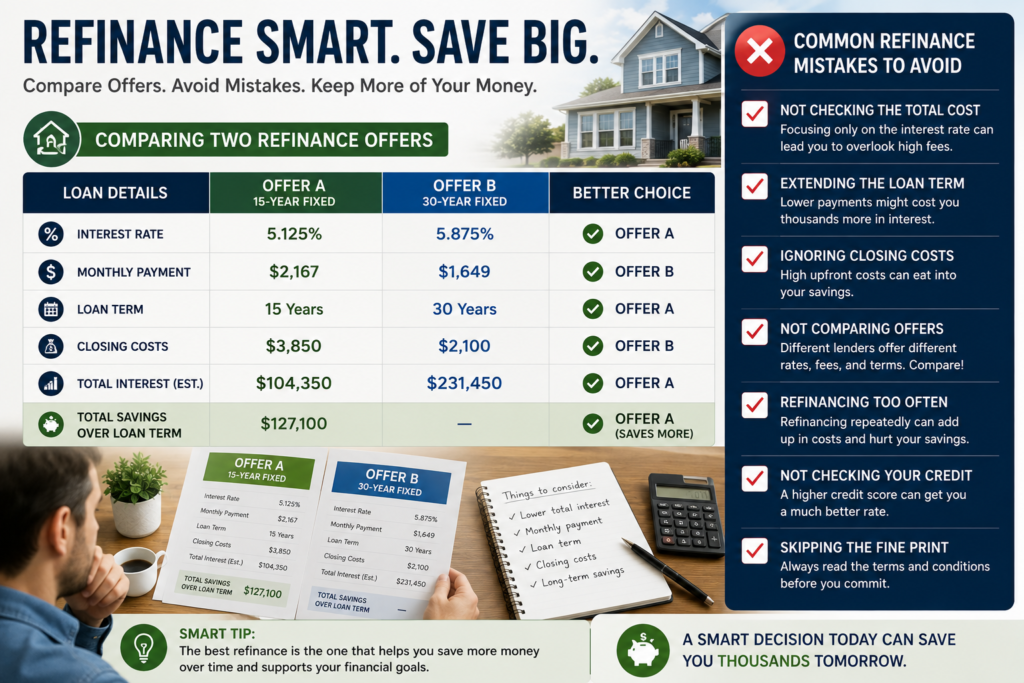
- Focusing only on monthly payment instead of total loan cost.
- Ignoring closing costs and lender fees.
- Extending your loan term without calculating total interest.
- Not comparing multiple lenders.
- Refinancing too frequently.
- Borrowing more than necessary with a cash-out refinance.
- Skipping the break-even calculation.
Avoiding these errors can make the difference between saving money and increasing your long-term borrowing costs.
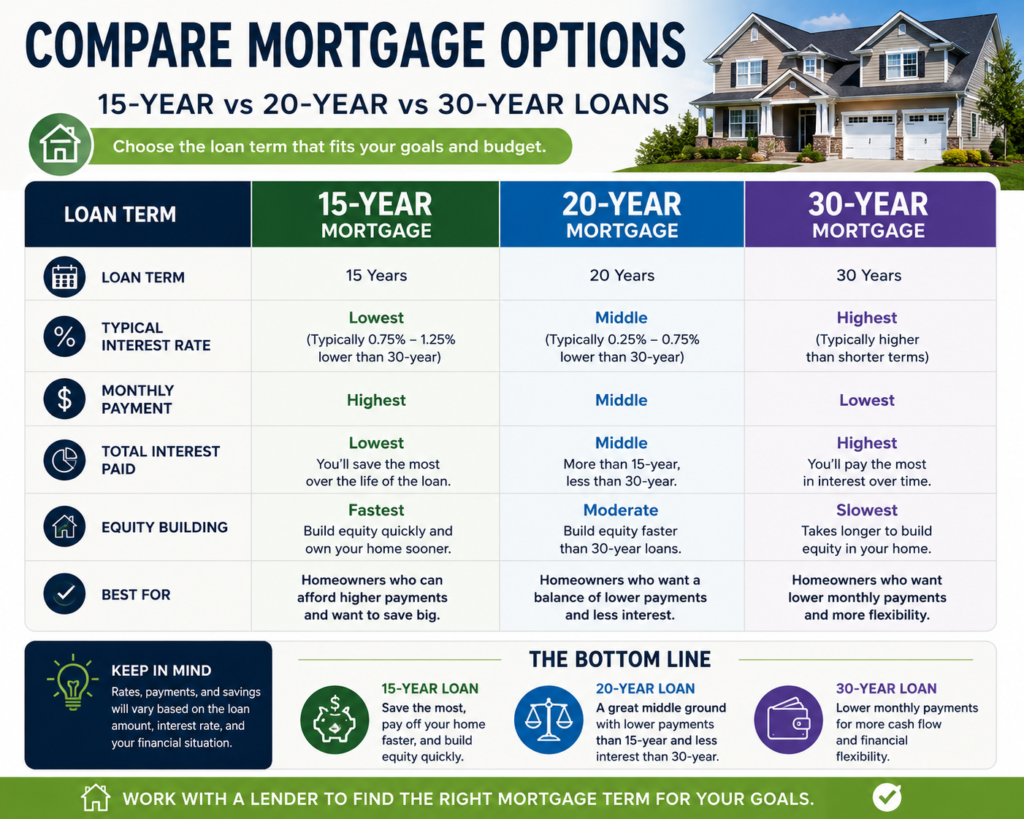
5. Choose the Right Loan Term
One of the biggest decisions you’ll make when refinancing is selecting your new loan term. Many homeowners automatically choose another 30-year mortgage because it offers the lowest monthly payment. However, that isn’t always the most cost-effective option.
The right loan term depends on your financial goals, monthly budget, and how long you plan to stay in your home.
15-Year Mortgage
A 15-year refinance typically comes with:
- Lower interest rates
- Faster home ownership
- Significant interest savings
- Higher monthly payments
Although your monthly payment may increase, you’ll usually pay far less interest over the life of the loan.
20-Year Mortgage
A 20-year mortgage offers a balance between affordability and long-term savings. It’s a good option for homeowners who want to reduce interest costs without the higher payments of a 15-year loan.
30-Year Mortgage
A 30-year refinance generally provides:
- Lower monthly payments
- Greater financial flexibility
- More cash available for investing or paying off other debts
The trade-off is paying more interest over the life of the loan.
Which Loan Term Is Best?
Consider:
- Your monthly income
- Retirement goals
- Emergency savings
- Future financial plans
- Job stability
Sometimes paying a little more each month can save tens of thousands of dollars in interest.
6. Lock Your Interest Rate at the Right Time
Mortgage interest rates can change daily—and sometimes multiple times in a single day.
Once you’ve found a refinance offer you’re happy with, ask your lender about locking your interest rate.
A rate lock guarantees your quoted rate for a specific period, often between 30 and 60 days, while your refinance is processed.
Benefits of a Rate Lock
- Protects you from rising interest rates
- Makes budgeting easier
- Eliminates uncertainty during closing
- Helps secure the savings you’ve planned for
If rates increase before closing and you haven’t locked your rate, your monthly payment could end up being higher than expected.
Some lenders also offer a float-down option, allowing you to benefit if rates fall before your loan closes. Ask whether this feature is available and whether it comes with additional fees.
7. Understand Mortgage Discount Points
Discount points allow you to pay money upfront in exchange for a lower interest rate.
Generally:
- One discount point equals 1% of the loan amount.
- Paying points can reduce your interest rate, leading to long-term savings.
For example:
Loan amount: $250,000
One discount point: $2,500
If paying $2,500 lowers your rate enough to save $80 per month, you would recover the cost after about 31 months.
When Paying Points Makes Sense
Buying discount points may be worthwhile if:
- You plan to stay in your home for many years.
- You want to reduce long-term interest costs.
- You have enough cash available after paying closing costs.
If you expect to move within a few years, paying points may not provide enough time to recover the upfront expense.
Always calculate your break-even point before deciding.

8. Eliminate Private Mortgage Insurance (PMI)
Private Mortgage Insurance (PMI) protects the lender if a borrower defaults on a conventional loan.
Unfortunately, it also increases your monthly mortgage payment.
Many homeowners continue paying PMI even after they have enough equity to remove it.
Refinancing can be an excellent opportunity to eliminate this extra expense.
You May Be Able to Remove PMI If
- Your home has increased in value.
- You’ve paid down your mortgage balance.
- You now own at least 20% equity in your home.
Removing PMI can reduce your monthly payment significantly, depending on your loan amount and insurance premium.
Before refinancing, ask your lender whether your current equity qualifies you for PMI removal.
9. Avoid Rolling Closing Costs Into Your Loan
Many lenders allow borrowers to finance their closing costs instead of paying them upfront.
While this can reduce your immediate out-of-pocket expenses, it usually increases the total cost of your mortgage.
Here’s why:
If you add $6,000 in closing costs to your mortgage balance, you’ll also pay interest on that $6,000 for many years.
Better Alternatives
- Pay closing costs in cash if possible.
- Negotiate lender credits.
- Compare lenders with lower fees.
- Ask whether certain fees can be waived.
Financing closing costs may make sense in some situations, but it’s important to understand the long-term impact before making a decision.
10. Don’t Focus Only on the Lowest Interest Rate
A low interest rate can be attractive, but it doesn’t always mean you’re getting the best refinance deal.
Some lenders advertise exceptionally low rates while charging higher fees, discount points, or closing costs.
Instead of comparing rates alone, review:
- Annual Percentage Rate (APR)
- Loan origination fees
- Discount points
- Underwriting fees
- Appraisal fees
- Closing costs
- Total loan cost over time
The APR provides a more complete picture because it includes many of the loan’s associated costs.
A slightly higher interest rate with lower fees may actually save you more money in the long run.
11. Refinance When Home Values Increase
Your home’s market value plays an important role in refinancing.
If your property has appreciated since you purchased it, refinancing may offer additional benefits.
Higher home values can:
- Increase your home equity.
- Improve your loan-to-value (LTV) ratio.
- Help you qualify for better interest rates.
- Make it easier to remove PMI.
For example, if you bought your home for $300,000 and it’s now worth $400,000, you may have gained enough equity to qualify for more favorable loan terms.
Before refinancing, ask your lender whether a new appraisal could improve your refinance options.

12. Watch Out for Hidden Fees
Mortgage refinance offers often include more than just the interest rate.
Review your Loan Estimate carefully to identify additional costs that could reduce your savings.
Common fees include:
- Loan origination fee
- Application fee
- Credit report fee
- Appraisal fee
- Title search fee
- Title insurance
- Recording fees
- Attorney fees (where applicable)
- Flood certification fee
- Underwriting fee
Not every fee is negotiable, but many lenders are willing to reduce or eliminate certain charges—especially if they know you’re comparing multiple offers.
Don’t hesitate to ask for a breakdown of every fee before committing to a refinance.
13. Consider a Cash-Out Refinance Carefully
A cash-out refinance allows you to replace your current mortgage with a larger loan and receive the difference in cash. Many homeowners use this money for home renovations, debt consolidation, education expenses, or other major financial needs.
While this option can be useful, it isn’t always the best way to save money.
When a Cash-Out Refinance Makes Sense
A cash-out refinance may be beneficial if you plan to:
- Renovate your home and increase its value.
- Consolidate high-interest debt, such as credit cards.
- Cover major medical or education expenses.
- Invest in improvements that provide a good return.
When to Avoid It
Avoid a cash-out refinance if you plan to use the money for:
- Vacations
- Luxury purchases
- New vehicles
- Everyday spending
Remember, you’re borrowing against your home’s equity. Increasing your loan balance means paying interest on that additional amount for many years.
Before choosing a cash-out refinance, compare it with alternatives such as home equity loans or personal loans to determine which option is the most cost-effective.
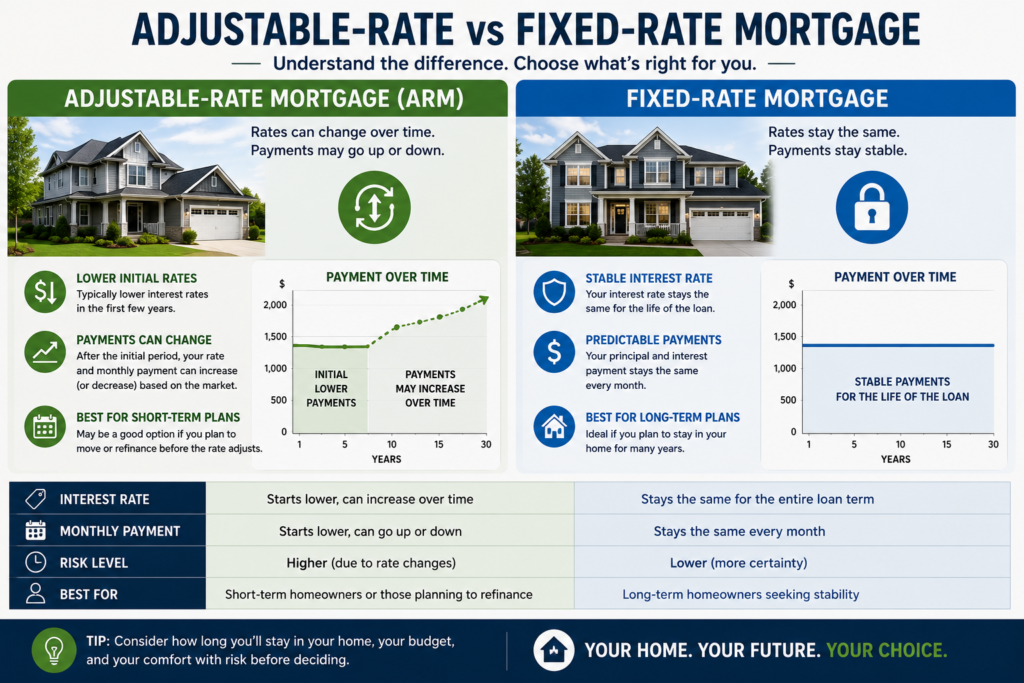
14. Switch From an Adjustable-Rate Mortgage (ARM) to a Fixed-Rate Mortgage
If you currently have an Adjustable-Rate Mortgage (ARM), refinancing into a fixed-rate mortgage can provide long-term financial stability.
ARMs often start with lower introductory interest rates, but after the initial period, the rate adjusts based on market conditions. This can lead to higher monthly payments if interest rates rise.
Benefits of a Fixed-Rate Mortgage
- Predictable monthly payments
- Protection from rising interest rates
- Easier household budgeting
- Greater long-term financial security
Although fixed-rate loans may have slightly higher initial rates than some ARMs, many homeowners value the peace of mind that comes with consistent payments.
If your ARM is nearing the end of its fixed-rate period, refinancing before the adjustment occurs could help you avoid future payment increases.
15. Continue Making Extra Principal Payments
Refinancing doesn’t have to be your final money-saving strategy.
Even after securing a lower interest rate, making extra payments toward your loan principal can significantly reduce the total interest you pay.
Benefits of Extra Principal Payments
- Pay off your mortgage sooner.
- Reduce total interest costs.
- Build home equity faster.
- Improve long-term financial security.
For example, adding just $100 to your principal payment each month could shorten your loan by several years, depending on your balance and interest rate.
Before making additional payments, verify that your lender applies the extra amount directly to the principal and that there are no prepayment penalties.
16. Avoid Common Mortgage Refinance Mistakes
Even a good refinance opportunity can become expensive if you make the wrong decisions.
Here are some of the most common mistakes homeowners make.
Refinancing Too Frequently
Every refinance comes with closing costs. Refinancing repeatedly within a short period may prevent you from recovering those expenses.
Ignoring the Break-Even Point
Always calculate how long it will take to recover your refinancing costs.
If you’re planning to move before reaching the break-even point, refinancing may not save you money.
Extending Your Loan Too Much
Refinancing into another 30-year mortgage can reduce monthly payments but may increase the total interest paid over time.
Consider whether a shorter loan term better aligns with your financial goals.
Borrowing More Than Necessary
Only refinance for the amount you truly need.
Increasing your loan balance means paying interest on additional debt.
Not Shopping Around
Mortgage rates and lender fees vary considerably.
Getting quotes from multiple lenders remains one of the easiest ways to save money.
Overlooking Loan Fees
A lower interest rate doesn’t always result in a lower overall loan cost.
Review all fees, including:
- Origination charges
- Discount points
- Appraisal costs
- Title fees
- Closing expenses
17. Review Your Financial Goals Before Refinancing
The best refinance isn’t necessarily the one with the lowest monthly payment.
Instead, choose the option that supports your long-term financial objectives.
Ask yourself:
- Do I want lower monthly payments?
- Am I trying to become debt-free sooner?
- Will I remain in this home for many years?
- Do I want to eliminate PMI?
- Am I refinancing to reduce interest costs?
- Is my emergency fund sufficient after paying closing costs?
Your answers will help determine whether refinancing is the right financial decision.
Remember that every homeowner’s situation is different. What works well for one family may not be the best option for another.
Mortgage Refinance Savings Checklist
Before signing your refinance documents, review this checklist:
✅ Compare at least three to five lenders.
✅ Review both the interest rate and APR.
✅ Calculate your break-even point.
✅ Improve your credit score before applying.
✅ Choose the loan term that fits your goals.
✅ Lock your interest rate when appropriate.
✅ Understand discount points before paying them.
✅ Remove PMI if you qualify.
✅ Review every closing cost and lender fee.
✅ Avoid borrowing more than necessary.
✅ Continue making extra principal payments whenever possible.
Frequently Asked Questions
Is refinancing always a good idea?
No. Refinancing is beneficial only when the long-term savings exceed the costs involved. Factors such as closing costs, loan terms, interest rates, and how long you plan to stay in your home all play an important role.
How much can refinancing save?
Savings vary depending on your mortgage balance, interest rate, and loan term. Some homeowners save a few thousand dollars, while others save tens of thousands over the life of the loan.
What credit score is needed to refinance?
Requirements differ by lender and loan program. Generally, higher credit scores qualify for lower interest rates and better loan terms.
How long does mortgage refinancing take?
Most refinance transactions take between 30 and 45 days, although the timeline can vary depending on the lender, appraisal process, and documentation requirements.
Can I refinance more than once?
Yes. There is no legal limit on how many times you can refinance. However, because each refinance typically includes fees and closing costs, it should only be done when the financial benefits outweigh the expenses.
Should I refinance if interest rates only drop slightly?
Not necessarily. A small rate reduction may still be worthwhile if it helps you remove PMI, shorten your loan term, or significantly reduce your overall borrowing costs. Always compare the total savings against the refinancing expenses.
Final Thoughts
Refinancing your mortgage can be one of the smartest financial decisions you make—but only when it’s done strategically. A lower interest rate, reduced monthly payment, shorter loan term, or the removal of PMI can save you thousands of dollars over the life of your loan.
The key is to look beyond the advertised interest rate. Compare multiple lenders, review the Annual Percentage Rate (APR), calculate your break-even point, understand all closing costs, and ensure the refinance aligns with your long-term financial goals. Taking the time to evaluate every detail can prevent costly mistakes and help you maximize your savings.
Remember that refinancing is not a one-size-fits-all solution. Your income, credit score, home equity, future plans, and current mortgage terms all influence whether refinancing is the right move. By applying the mortgage refinance savings tips covered in this guide, you’ll be in a stronger position to make an informed decision that benefits your finances for years to come.
Whether your goal is to lower monthly payments, pay off your mortgage faster, or reduce total interest costs, careful planning and thorough comparison shopping can make a significant difference. A well-timed refinance has the potential to improve your financial stability and free up money for other important goals, such as saving for retirement, investing, or building an emergency fund.

I’m Grayson Watson, your frugal companion and the brain behind this money-saving extravaganza. Strap yourself in, because we’re about to embark on a wallet-friendly adventure like no other. Learn More!