
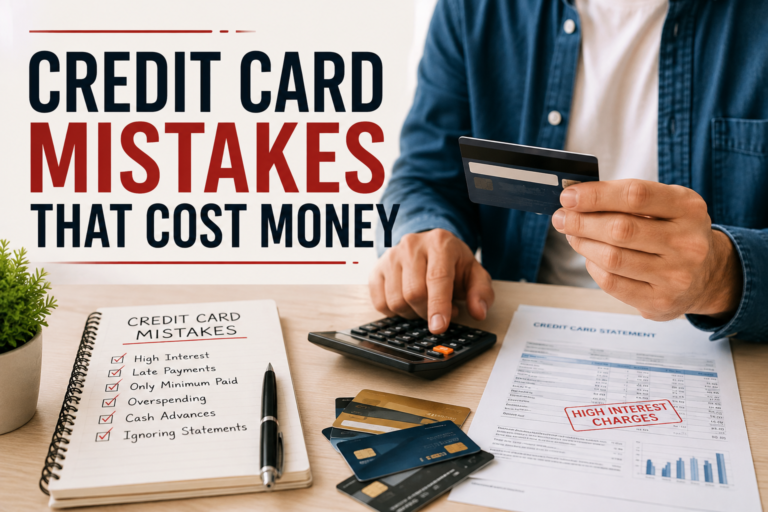
Credit cards can be incredibly useful. They make everyday purchases convenient, can help build your credit history, provide additional purchase protection, and may even reward you with cash back, points, or travel benefits.
But there is another side to credit cards that is easy to underestimate. A few seemingly small mistakes can quietly cost you hundreds—or even thousands—of dollars over time.
I used to think the biggest credit card mistake was simply spending too much. While overspending is certainly a problem, I have learned that there are many other ways credit cards can drain your budget. Paying only the minimum, carrying balances unnecessarily, ignoring your APR, missing payment dates, and chasing rewards can all make borrowing far more expensive than expected.
The good news is that most of these mistakes are preventable. If you understand how credit cards work and develop a few simple habits, you can use them as financial tools instead of allowing interest and fees to eat into your income.
Here are some of the most common credit card mistakes that cost money—and practical ways to avoid them.
1. Carrying a Credit Card Balance When You Don’t Need To
One of the most expensive credit card habits is carrying a balance from month to month.
There is a common misconception that leaving a small balance on your credit card somehow improves your credit score. You generally do not need to carry interest-bearing debt to build credit.
If your card has a grace period and you pay the statement balance in full by the due date, you can typically avoid interest on purchases while still showing responsible credit use.
The problem begins when part of the statement balance rolls into the next billing cycle. Imagine you have a $3,000 credit card balance with a relatively high APR. If you continue carrying that debt for months while making small payments, interest can consume a significant portion of every payment.
You might send $100 to the credit card company and assume your debt has fallen by $100. In reality, part of that money may have gone toward interest.
Better approach:
Whenever your finances allow, aim to pay the full statement balance by the due date. If you already have credit card debt, focus on paying substantially more than the minimum while avoiding additional purchases on the card where possible.

2. Paying Only the Minimum Payment
The minimum payment can look surprisingly affordable.
You might owe $5,000 and see a minimum payment of only $100 or $150. Paying that amount may keep the account current, but it doesn’t necessarily mean you are making fast progress toward becoming debt-free.
Minimum payments are designed to satisfy the card’s monthly payment requirement—not to help you eliminate the debt quickly.
When your APR is high, a meaningful portion of your payment can go toward interest.
This can create a frustrating cycle:
- You make your payment.
- Interest is charged.
- Your balance falls slowly.
- Then you continue using the card.
- Before long, it feels like the balance barely moves.
Whenever possible, treat the minimum payment as the absolute floor rather than your target.
For example, if your minimum payment is $90 but your budget allows you to pay $250, paying the higher amount could significantly reduce both your repayment time and total interest expense.
3. Missing Your Credit Card Due Date
Missing a payment is another mistake that can become expensive quickly.
Depending on your card agreement and circumstances, a late payment can potentially result in a late fee, additional interest costs, loss of promotional terms, or negative credit consequences if the payment becomes sufficiently delinquent.
The frustrating part is that late payments aren’t always caused by a lack of money. Sometimes people simply forget.
You may receive your salary on the 25th while your card is due on the 22nd. Or you may have multiple credit cards with different payment dates and accidentally overlook one. A simple system can prevent many of these problems.
Consider setting up automatic payments for at least the minimum payment. You can then manually pay the remaining statement balance before the due date. Calendar reminders can also help.
I like the idea of having two reminders: one several days before the payment is due and another close to the actual due date. That gives you time to move money between accounts if necessary.
4. Not Knowing Your Credit Card APR
Ask someone how much credit card debt they have, and they may know the exact number. Ask them what APR they are paying, and they may have no idea. That can be an expensive oversight.
APR, or annual percentage rate, is one of the most important numbers to understand when you carry a credit card balance. Two cards with the same balance can cost very different amounts depending on their interest rates.
Suppose you have multiple credit cards:
- Card A: $2,000 balance at 18% APR
- Card B: $2,000 balance at 24% APR
- Card C: $2,000 balance at 29% APR
If you are trying to reduce the total amount of interest you pay, putting extra money toward the highest-interest debt can often make financial sense while continuing to make the required payments on your other accounts. Don’t just look at your balances. Know your interest rates too.
5. Treating Your Credit Limit Like Available Income
If a credit card company gives you a $10,000 limit, that does not mean you can afford to spend $10,000. A credit limit is a borrowing limit—not an extension of your salary.
This distinction sounds obvious, but psychologically it can be difficult. If you have $800 in your checking account but $12,000 in available credit, a $1,500 purchase may suddenly seem possible.
Technically, the transaction might go through. Financially, however, you may not be able to afford it.
One rule I find useful is simple:
Don’t ask, “Do I have enough available credit?”
Ask:
“Could I comfortably pay for this purchase when my statement is due?”
That question completely changes how you look at credit card spending.
6. Using Credit Cards for Impulse Purchases
Credit cards remove some of the psychological friction associated with spending. Handing over $300 in cash feels very different from tapping a card.
That convenience can make impulse purchases easier. A new phone, clothes, home décor, restaurant meals, gadgets, or online shopping may not seem particularly expensive individually. But dozens of small purchases can produce a surprisingly large statement at the end of the month.
One way to control this is to create a waiting period for non-essential purchases.
For example:
- For purchases above $50, wait 24 hours.
- For purchases above $200, wait several days.
During that time, ask yourself whether you actually need the item and whether you can pay for it without carrying additional debt. You may be surprised how often the desire disappears.

7. Chasing Credit Card Rewards While Carrying Debt
Credit card rewards can be useful. Cash back, airline miles, hotel points, and welcome bonuses can provide genuine value when used responsibly. But rewards become far less attractive when you are paying substantial interest.
Imagine earning 2% cash back on purchases while carrying a balance at a much higher interest rate. You may feel like you are earning money every time you use the card, but the interest expense can easily outweigh the rewards you receive.
This is why I think rewards should be treated as a bonus rather than a reason to spend. If you were going to buy $100 worth of groceries anyway and can pay your statement balance in full, earning rewards may make sense.
Spending an extra $500 simply to collect points is different. Never spend $100 unnecessarily just because someone promises to give you $2 back.
8. Taking a Cash Advance Without Understanding the Cost
A credit card cash advance can look like convenient emergency money. It can also be expensive.
Cash advances may have different fees and interest terms from ordinary purchases. In many cases, interest can begin accruing immediately rather than benefiting from the same grace period that may apply to purchases.
Before using a credit card to withdraw cash, check your cardholder agreement carefully. Look for the cash advance APR, transaction fee, and when interest begins accruing. If you are dealing with a financial emergency, compare the total cost of your available options rather than automatically reaching for a cash advance.
9. Ignoring Credit Card Fees
Interest isn’t the only way credit cards cost money.
Depending on the card, you could encounter fees related to things such as:
- Annual membership
- Late payments
- Balance transfers
- Cash advances
- Foreign transactions
- Returned payments
This doesn’t automatically make a card with fees a bad card. For example, an annual-fee travel card could potentially provide benefits worth more than its annual cost for someone who travels frequently.
But paying an annual fee for benefits you never use doesn’t make much sense. Review your cards at least once a year.
Ask yourself:
What did this card cost me during the last 12 months?
Then ask:
What value did I actually receive?
If the numbers don’t make sense, investigate whether a different card or product change would better fit your spending habits.
10. Maxing Out Your Credit Cards
Getting close to your credit limit can create several problems. First, it gives you very little room for unexpected expenses. Second, high balances relative to your available credit can affect credit utilization, which is an important factor in many credit-scoring models.
Third, maxed-out cards often indicate a larger budgeting problem. For example, if you have a $5,000 limit and consistently carry a balance near $4,800, simply increasing the limit may not solve the underlying issue.
Look at why the balance keeps growing.
- Are groceries exceeding your budget?
- Are you using credit cards to cover rent or utilities?
- Are subscriptions quietly adding up?
- Has your income fallen?
Finding the cause is often more important than temporarily finding more credit.

11. Opening Too Many Credit Cards for Sign-Up Bonuses
Welcome bonuses can be tempting. Spend a certain amount within the first few months and receive points, miles, or cash back.
The problem begins when the spending requirement influences your behavior. Suppose you normally spend $1,500 during a particular period but need to spend $4,000 to receive a bonus.
If you manufacture an additional $2,500 of unnecessary spending just to qualify, you haven’t really saved money. You’ve spent more money to receive a reward.
There are also other factors to consider before repeatedly applying for new cards, including your ability to manage multiple accounts, payment dates, fees, credit inquiries, and the temptation to increase spending.
Credit card bonuses should fit your normal financial life—not force you to change your spending habits.
12. Forgetting About Promotional APR Expiration Dates
A 0% introductory APR offer can be extremely useful. For example, someone paying down existing credit card debt may use an eligible balance-transfer promotion to reduce interest temporarily.
But there is one date you absolutely need to know:
When does the promotional period end?
If you transfer a balance and then forget about it, you could eventually find yourself paying the card’s regular APR on the remaining debt after the promotional period expires, subject to the specific terms of the offer.
Create a repayment schedule from the beginning. Suppose you transfer $6,000 to a card offering an 18-month qualifying promotional period.
Instead of thinking, “I have 18 months,” calculate how much you would need to pay each month to eliminate the balance before the promotion ends. Also remember that balance transfers may involve fees, so calculate the total cost before making the move.
13. Using One Credit Card to Solve Problems Created by Another
This is where credit card debt can become dangerous financially.
You have Card A. The balance gets too high.
You open Card B.
Then Card B fills up.
You apply for Card C.
Eventually, you’re not solving the debt problem. You’re moving it around. Balance transfers and consolidation strategies can sometimes be useful, but only when they are combined with a realistic repayment plan.
If your monthly expenses are consistently higher than your income, moving debt between accounts won’t fix the underlying cash-flow problem. At some point, the spending side of the equation needs attention.
Go through your expenses carefully. Separate necessities from optional spending. Look at housing, transportation, insurance, food, subscriptions, entertainment, and recurring charges.
Sometimes the best credit card strategy has very little to do with the credit card itself. It starts with your budget.
Final Thoughts
Credit cards aren’t automatically good or bad. The outcome depends heavily on how you use them.
Someone who pays the statement balance in full, monitors transactions, avoids unnecessary fees, and stays within a realistic budget may be able to enjoy convenience and rewards without paying significant interest on purchases.
Someone else can use the same credit card and end up trapped in years of expensive debt. That’s why the small habits matter.
Know your APR. Pay on time. Avoid treating your credit limit as income. Don’t overspend for rewards. Review your statements. Understand promotional offers. And whenever possible, pay your statement balance in full by the due date.
Most importantly, don’t look at a credit card purchase only in terms of whether the transaction will be approved.
Ask yourself a better question:
Can I comfortably afford to pay for this when the bill arrives?
That one habit can prevent many of the credit card mistakes that cost people the most money.
This article is for general educational purposes and isn’t individualized financial advice. Credit card fees, interest calculations, grace periods, promotional offers, and other terms vary by issuer and account, so check your cardholder agreement for details.

I’m Grayson Watson, your frugal companion and the brain behind this money-saving extravaganza. Strap yourself in, because we’re about to embark on a wallet-friendly adventure like no other. Learn More!