
Have you ever looked at your bank account near the end of the month and wondered where all your money went?
Maybe there wasn’t one huge purchase. Instead, it was €8 here, €15 there, a quick takeaway dinner, another online order, a coffee on the way to work, and a few subscriptions you barely use.
Individually, these expenses don’t always feel important. Together, they can take a surprisingly large bite out of your monthly budget.
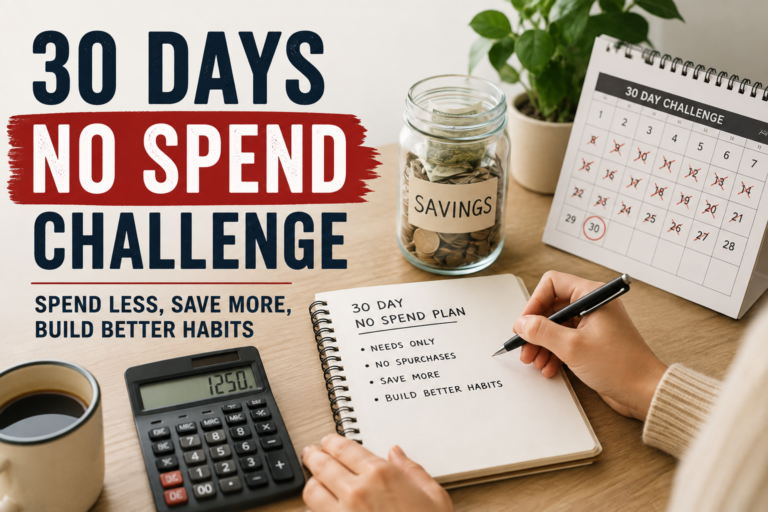
That’s exactly why a 30 Days No Spend Challenge can be so useful.
The idea isn’t to stop spending money completely. You still need to pay your rent, buy groceries, commute to work, take necessary medication, and cover your regular bills.
Instead, the challenge is about temporarily cutting out unnecessary spending for 30 days.
It’s less about punishment and more about finding out where your money is actually going.
What Is a 30 Days No Spend Challenge?
A 30-day no-spend challenge is a personal money-saving challenge where you avoid non-essential purchases for an entire month.
Your essential expenses continue as normal.
These could include:
- Rent or mortgage
- Electricity and utilities
- Basic groceries
- Insurance
- Transportation
- Necessary medication
- Phone and internet
- Minimum debt payments
- Other unavoidable household bills
The spending you temporarily eliminate is everything that isn’t genuinely necessary.
For example, you might stop spending on restaurant meals, takeaway coffee, clothing, entertainment purchases, impulse shopping, home décor, beauty products you don’t need, and random online purchases.
The exact rules don’t have to be identical for everyone.
Someone with children will have different essential expenses from a single person. Someone who drives to work every day may consider fuel essential, while someone working from home might not.
The important part is deciding your rules before Day 1.

Why Try a No-Spend Month?
The obvious reason is to save money, but that’s only part of the benefit.
A no-spend month forces you to pay attention.
When buying something is always an option, it’s easy to spend automatically. You see something you like, click “buy,” and move on.
During a no-spend challenge, you have to stop and ask:
Do I actually need this?
That simple question can change the way you think about money.
You may discover that you buy takeaway food whenever you’re tired, browse online stores when you’re bored, or spend money socially because you don’t want to say no.
Once you recognize those patterns, they become easier to control.
And there’s another benefit: after 30 days, some things you thought you needed may no longer seem important.
Step 1: Decide What Counts as Essential
Before starting your challenge, divide your spending into two categories: essential and non-essential.
Your essential list might include groceries, housing, utilities, transportation, insurance, childcare, medication, and debt payments.
Your non-essential list might include:
- Restaurant meals
- Food delivery
- Coffee shop visits
- New clothes
- Gadgets
- Entertainment purchases
- Unnecessary beauty products
- Home decorations
- Hobby shopping
- Convenience purchases
- Impulse buys
Be realistic.
A no-spend challenge that is ridiculously strict can become difficult to maintain. Your goal isn’t to create the hardest challenge possible. Your goal is to complete the full 30 days and learn something from it.
Step 2: Give Yourself a Grocery Budget
“No spend” doesn’t mean “don’t eat.”
Food is obviously necessary.
Instead of eliminating grocery spending, set a realistic grocery budget and try to stick to it.
This is also a good opportunity to use food you already have.
Before making your next grocery list, check your freezer, refrigerator, pantry, and cupboards. You might already have pasta, rice, canned beans, frozen vegetables, bread, oats, sauces, lentils, or other ingredients that can become several meals.
- Plan your meals around those ingredients first.
- Then purchase only what you need to complete the meals.
- This reduces both grocery spending and food waste.

Step 3: Remove Your Biggest Spending Temptations
Willpower helps, but changing your environment can make the challenge much easier. If online shopping is your weakness, unsubscribe from promotional emails. Remove saved payment information from shopping websites. Delete shopping apps from your phone temporarily.
If food delivery is your weakness, remove those apps too. If you constantly buy things after seeing them on social media, stop following shopping-focused accounts for a month.
Adding even a little friction between yourself and a purchase gives you time to reconsider it. Instead of immediately buying something, add it to a 30-day wish list. If you still genuinely want it when the challenge ends, you can reconsider the purchase then. You may be surprised by how many things you completely forget about.
Step 4: Find Free Alternatives
One reason people quit no-spend challenges is that they start feeling deprived.
You don’t need to spend 30 days sitting at home doing nothing.
Instead, make the challenge about finding alternatives.
Rather than meeting someone at an expensive restaurant, invite them over for coffee.
Instead of paying for entertainment, watch something on a subscription you’re already paying for.
Go walking, hiking, cycling, visit a free museum day, use your local library, cook with friends, have a movie night at home, or explore free community events.
You can still enjoy yourself.
You’re simply removing the assumption that enjoying your free time always requires spending money.

Step 5: Track Every Purchase
Even though you’re trying not to spend, track the money you do spend. You don’t need a complicated spreadsheet. A notebook works perfectly well. Write down every purchase during the challenge.
For example:
Day 3 — Groceries — €42
Day 7 — Train ticket — €12
Day 12 — Pharmacy — €9
Recording your expenses makes spending visible. At the end of each week, review the list. Ask yourself whether everything you bought was genuinely necessary. Don’t use this exercise to feel guilty about spending. Use it to understand your habits.
What If You Accidentally Spend Money?
Imagine you’ve completed 11 days without unnecessary spending. Then you’re tired after work and order a €20 takeaway. Is the entire challenge ruined?
No.
Record the purchase and continue with Day 12. One mistake doesn’t erase everything you’ve accomplished. The dangerous mindset is:
“I already failed, so I might as well quit.”
Instead, ask why the purchase happened. Were you tired? Did you forget to prepare dinner?
Were you stressed? Were you simply craving something?
Understanding the trigger is more valuable than pretending mistakes never happen. Next time, you can prepare for it.
Try the 24-Hour Rule
During the challenge, whenever you want something that isn’t essential, write it down instead of purchasing it. Then wait at least 24 hours. For more expensive purchases, consider waiting until the entire challenge is finished.
Impulse purchases feel urgent in the moment. A few days later, they often don’t.
You might write down:
New shoes — €70
Kitchen gadget — €35
Home décor — €25
Takeaway dinner — €22
New shirt — €40
That’s €192 worth of spending you potentially avoided simply by waiting.

Create a “Money Saved” Total
This is one of the most motivating parts of the challenge. Whenever you decide not to buy something you normally would have purchased, write down the amount.
Skipped takeaway: €25.
Skipped clothing purchase: €45.
Skipped coffee: €5.
Skipped online order: €35.
Now you’ve avoided €110 in spending.
If possible, transfer some or all of that money into savings.
Watching your savings balance increase gives the challenge a purpose.
Instead of thinking:
“I can’t spend €25 on takeaway.”
You start thinking:
“I just kept another €25.”
That’s a completely different feeling.
A Simple 30-Day No-Spend Plan
You don’t need to make every day complicated.
During Days 1–7, focus on awareness. Track your spending, avoid unnecessary purchases, eat what you already have, and identify your biggest temptations.
During Days 8–14, start replacing expensive habits. Make coffee at home, prepare lunches, find free entertainment, and reduce convenience spending.
During Days 15–21, review your progress. Calculate how much you’ve avoided spending and identify the categories where you’re saving the most.
During Days 22–30, think beyond the challenge. Decide which habits you want to continue after Day 30.
The final week is especially important because the purpose isn’t simply to survive one month without shopping.
The real goal is to change what happens in Month 2.
How Much Could You Save?
There isn’t one correct amount. Someone who already lives very frugally may save €100 or €200. Someone who frequently eats out, shops online, and spends heavily on entertainment could potentially save several hundred euros.
For example, imagine your normal month includes:
Takeaway and restaurants: €180
Coffee and snacks: €70
Clothing and online shopping: €150
Entertainment: €80
Random impulse purchases: €120
That’s €600 in discretionary spending.
Even if you only eliminate two-thirds of it during your challenge, that’s around €400 kept in your pocket. Your numbers may be completely different. That’s why tracking your own spending matters more than comparing your results with someone else’s.

What Should You Do With the Money You Save?
Try not to finish your challenge and immediately spend everything you saved. Give that money a job.
Depending on your financial situation, you could use it to:
- Start an emergency fund
- Increase your existing savings
- Pay down credit card debt
- Make an extra loan payment
- Save toward an upcoming expense
- Build a car repair fund
- Save for travel
- Start a sinking fund for annual bills
Even a relatively small amount can become the beginning of a useful financial cushion.
If you save €300 during the challenge and repeat a smaller version of the challenge several times throughout the year, the effect can become significant.
What Happens After Day 30?
Day 31 shouldn’t automatically mean returning to every old spending habit. Look back at your month.
Which purchases did you miss? Which ones did you completely forget about? Maybe you discovered that bringing lunch to work wasn’t difficult.
Maybe you realized you don’t need takeaway three nights a week. Perhaps waiting before online purchases helped you avoid buying things you didn’t actually want. Those are the habits worth keeping.You don’t have to live permanently under strict no-spend rules.
Instead, create a more intentional version of your normal budget. Maybe you allow yourself two restaurant meals per month instead of eight. Maybe you keep the 24-hour purchase rule.
Maybe you introduce one no-spend weekend every month. The challenge becomes valuable when some of the lessons survive beyond the 30 days.
Final Thoughts
A 30 Days No Spend Challenge isn’t about proving that you can live without spending money.
It’s about discovering how much of your spending is intentional and how much happens automatically. For 30 days, you temporarily separate your needs from your wants.
- You cook more meals at home.
- You pause before buying things.
- You find free alternatives.
- You pay attention to where your money goes.
And hopefully, you finish the month with more money than you normally would have had. But the biggest win may not be the amount sitting in your savings account. It may be realizing that you have more control over your spending than you thought.
Start with Day 1. Set your rules, track your spending, and see how much you can keep over the next 30 days.
This article is for general educational purposes and is not individualized financial advice. Essential expenses and appropriate savings priorities vary depending on personal circumstances.

I’m Grayson Watson, your frugal companion and the brain behind this money-saving extravaganza. Strap yourself in, because we’re about to embark on a wallet-friendly adventure like no other. Learn More!